












Overview
Bad sectors are areas of a disk that can no longer reliably store data. Left unchecked, they cause corruption, crashes, and data loss. This guide explains the types of bad sectors and shows how to check your disk’s health and repair errors using built-in Windows tools and trusted utilities.
Check and repair disk errors before they cause data loss.
Key Takeaways
- Soft (logical) bad sectors can often be repaired; hard (physical) ones cannot.
- CHKDSK with /f /r is the main built-in repair tool.
- Back up your data first — repairs on a failing disk can be risky.
- Frequent or growing bad sectors mean the drive is failing and should be replaced.
Types and Causes
- Soft bad sectors — logical errors, often fixable by CHKDSK.
- Hard bad sectors — physical damage that cannot be repaired (the area is marked unusable).
- Causes include sudden power loss, physical shock, ageing drives, and malware.
- Signs: slow performance, frequent freezes, corrupted files, and unusual noises.
Check Disk Health From Settings
1. Open Settings > System > Storage > Advanced storage settings > Disks & volumes.
2. Select your drive and open its Properties.
3. Review the drive health/SMART status (especially useful for SSDs).
Check From File Explorer
1. Open File Explorer, right-click the drive, and choose Properties.
2. Open the Tools tab and click Check under Error checking.
3. Let Windows scan and repair file-system errors.
Check Drive Status From Command Prompt
1. Open Command Prompt as administrator.
2. Run: wmic diskdrive get status — "OK" means the drive reports healthy.
3. For SMART detail, use a tool like CrystalDiskInfo.
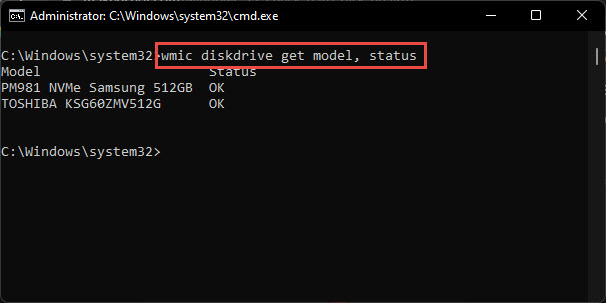
Check the drive status from Command Prompt.
Repair With CHKDSK
1. Open Command Prompt as administrator.
2. Run: chkdsk C: /f /r /x (replace C: with your drive).
3. /f fixes errors, /r locates bad sectors and recovers readable data, /x dismounts the volume first.
4. For the system drive, allow it to schedule the scan on the next restart, then reboot.
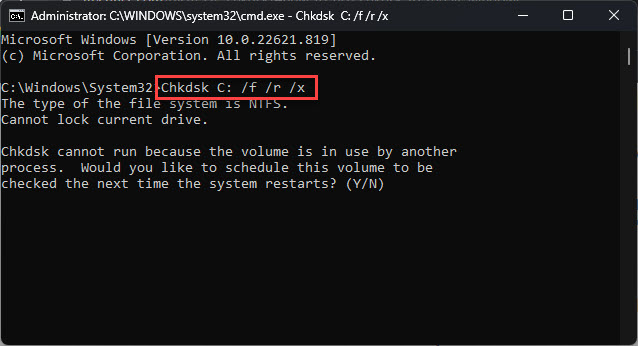
Run CHKDSK to find and repair bad sectors.
Repair With PowerShell
1. Open PowerShell as administrator.
2. Scan: Repair-Volume -DriveLetter C -Scan
3. Repair: Repair-Volume -DriveLetter C -OfflineScanAndFix
Third-Party Disk Tools
- Hard Disk Sentinel — detailed health, temperature, and SMART monitoring.
- HD Tune Pro — error scanning and benchmarking.
- SeaTools (Seagate) / vendor tools — manufacturer diagnostics for your drive.
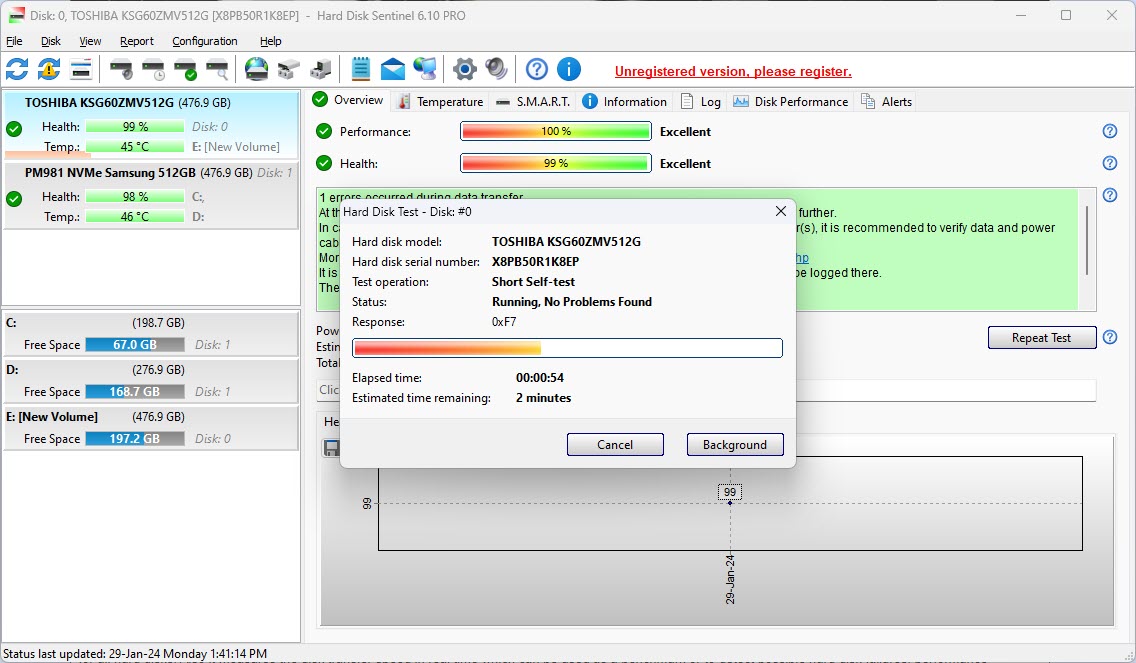
Tools like Hard Disk Sentinel monitor disk health in detail.
Warning: If a drive shows physical bad sectors or a failing SMART status, back up immediately and replace it — repairs cannot restore physically damaged sectors.
Troubleshooting
Problem: CHKDSK gets stuck or runs very long.
Solution: Large or failing drives take time, especially with /r. Leave it running; if it hangs for many hours on a failing disk, back up and replace the drive.
Problem: CHKDSK cannot run because the volume is in use.
Solution: Use /x to dismount, or schedule the scan for the next restart and reboot.
Problem: Bad sectors keep coming back.
Solution: The drive is physically failing. Back up your data and replace it.
Problem: It is an SSD.
Solution: SSDs do not have traditional bad sectors; check SMART health and run the manufacturer’s tool, and ensure firmware is up to date.
Conclusion
Regular disk checks catch problems early. Use CHKDSK or Repair-Volume to fix logical errors and recover data from soft bad sectors — but treat physical bad sectors or a failing SMART status as a signal to back up and replace the drive.
</w:pBdr><w:spacing w:before="220" w:after="40"/></w:pPr><w:r><w:rPr><w:b/><w:bCs/><w:color w:val="0B5394"/><w:sz w:val="21"/><w:szCs w:val="21"/><w:rFonts w:ascii="Calibri" w:cs="Calibri" w:eastAsia="Calibri" w:hAnsi="Calibri"/></w:rPr><w:t xml:space="preserve">About TechHub
This guide is part of the TechHub Knowledge Base. For more step-by-step IT guides and support, visit techhub.com.lk.